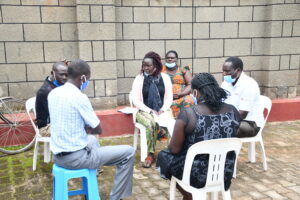
Our team at HealthRight Uganda assisted the World Health Organization (WHO) in adapting the Self Help Plus (SH+) manual into Juda Arabic, a dialect spoken by the people of South Sudan. These manuals serve as critical resources and a model for scaling up a mental health and psychosocial support program in humanitarian settings called SH+. The Juda Arabic model is added to the list of languages that the model is available in – English, Spanish, Arabic, Juba Arabic, Ukrainian and Turkish.
Since partnering in 2018 with World Health Organization (WHO) to pilot and evaluate SH+ in Uganda as an innovative, scalable psychosocial support intervention for South Sudanese refugee women, including those surviving gender-based violence, we expanded this evidence-based, self-help workshop series for global populations.
These translations are greatly supportive as they will enable non-specialists on the ground to better serve marginalized groups and promote community engagement, allowing locals to seek involvement and become a part of the solution. This notion of community-driven solutions – forging partnerships with local communities to improve health outcomes – is one of HealthRight's key targets and is only possible with the correct tools for engagement. This new translation is an extremely vital tool that will enable HealthRight to support yet another swath of the population.
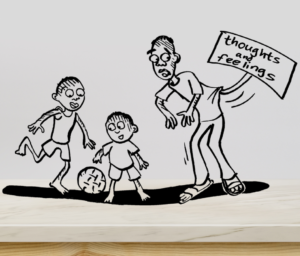
Run by non-specialists, SH+ is a series of workshops based on acceptance and commitment therapy; the program requires minimal training, using audio and illustrated tools to deliver vital mental health care to large, low-literacy groups. The Self-Help Plus (SH+) Mental Health model enables scaling up of uptake of services in all health programs and projects as a blended intervention into various health themes like HIV/AIDS, Maternal and Child Health, and Adolescent Sexual and Reproductive Health.
The tools for the SH+ sessions are available online through the WHO website.