Written by Valentina Duron
The language that we use regarding mental health can alter our perception of it. It can make a problem personal by appealing to our humanity or it can isolate individuals from a community. We can choose to accept these issues or we can intentionally or unintentionally choose to reject them. When thinking about the human brain I believe that it’s a problematic message, “neurotypical” and that of “neurodivergent”. It sends out the message that there is one way in which people should function, think and feel. It suggests that if someone falls outside that spectrum there is something flawed in the way they are “wired”. Our minds are complex; they enable our curiosity, our communication, and our consciousness.
Genetically and biologically we are all different, yet, our body’s composition still shares so many similarities. I think the same applies to our minds in the sense that every mind is a different world built from the same structures. Our minds function due to the work of the human brain. During the prenatal period and early childhood we are developing our basic brain structure, but the refinement and the formation of the rest of our mental processes will continue to develop through time. Our experiences, our community, our caregivers, our culture, our race, our age, our religion, they alter the way we understand our thoughts and our behaviors.
When people hear the word psychology or issues related to it they have the tendency to make associations with words that have negative connotations. They often think of words such as disease, disordered, or disruptive. While failing to recognize it as the study of the mind and behavior. The same applies to the term mental health, as a society we have struggled to go beyond the narrative of illness. So, how do we check in on someone’s mental health if they don’t fully comprehend what it is in the first place? How do we know someone’s truly understood what we are talking about when we survey mental health if we’re not using the right language?
 The Patient Health Questionnaire (PHQ) 2 and 9 are screening tools used worldwide to diagnose depressive disorders. The PHQ2 is derived from the PHQ9 and it is a rapid screening tool with only two questions. It frames the questions as “Over the last 2 weeks, how often have you been bothered by the following problems?”. The first question asks “ Little interest or pleasure in doing things” and the second question asks “Feeling down, depressed or hopeless”. In most settings PHQ2 is administered and according to those scores clinicians or registered professionals can refer individuals to the PHQ9 for further assessment. Yet, I can’t help but wonder what happens when we misinterpret the questions?
I struggle with the fact that our experiences and our biases influence our perception of the world. Which is why I think about all the people who fall through the cracks and go through life struggling in silence. It’s entirely frustrating to be unable to express and identify what is going on in our minds. It’s like the experience of going to a foreign country without speaking the language. You may have so much to share, but most people can’t understand you. This silence and vulnerability has repercussions such as isolation, discrimination, and poor quality of life and health. It’s so important that as we progress to a world where mental health is talked about globally and that we adapt and innovate the tools that we give individuals to identify and express their emotional and mental wellbeing. Culture can change the way that we think about certain situations because there may be different beliefs about certain structures and emotions. Language is the tool we use to convey our ideas and cultural beliefs, it is the principal method of human communication. About 7,117 known languages are spoken around the world, (TheIntrepidGuide,2023). Now think about all the words in all the languages that don’t have direct translations. How do we make sense of them in new settings? For a global mental health approach we need global standards, but we also need a locally, inclusive, and sustainable initiative.
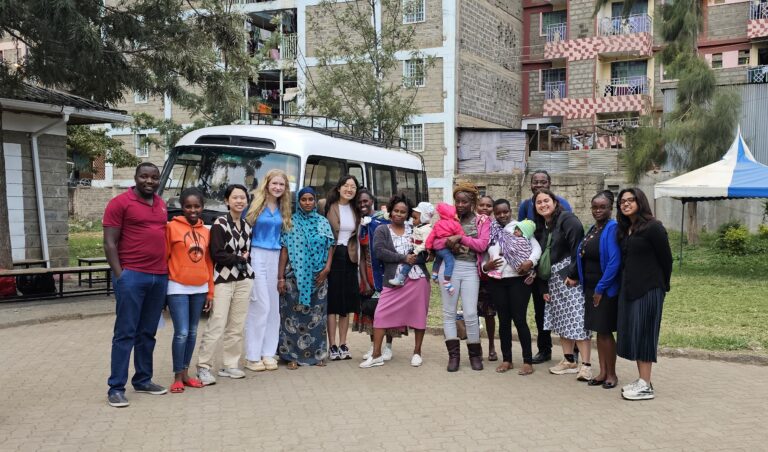
I was fortunate enough to visit an outreach site from HealthRight’s project in Kenya, “Improving The Mental Health of Perinatal Women in Nairobi’s Informal Settlement” which addresses the gap in awareness and education when it comes to what mental health means. I heard from a group of mothers that shared their journey navigating through their mental health. As well as the community health workers that administered assessments, supervised group therapies, and improved psychoeducation.
“Our health is our responsibility” is the slogan of this project, which they’ve adopted as the foundation for the services and care they provide. I think it’s a powerful statement. It speaks to the autonomy and “championing” of mental health into something deeply powerful and personal. “Unhooked… when people are hooked we can help to unhook them” was something that one of the community health volunteers (CHV) shared about their sessions during their focus group. I was intrigued because I’ve never heard mental health being referenced this way before, but for me it portrayed that moment when the CHV truly sees a community member and understands what they’re going through.
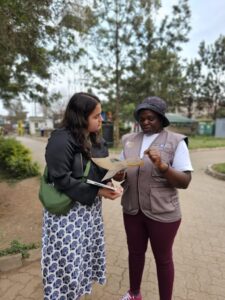
During outreaches the CHVs use a booklet that outlines what mental health is, they start by having a conversation and they proceed to educate and fill gaps about what a person may be experiencing. When I think about the type of approach we need to take I think this outreach highlighted some of the most important parts such as truly trying to understand our people and our community and making it our responsibility to make a difference. We become “champions” of our community when we approach our health as something fundamental.
From my experience at language labs the words and utterances children use when they are developing are seen as markers of who a kid will grow up to be or they speak volumes of the speed and quality of their development. I believe that if we were to take into account the power behind our words, just as much as we do when we’re children, it would be a different world. In the field of psychology we put faith in the intentions behind what children are saying. Their words and babbles carry weight because they’re learning to communicate and they’re learning their place in the world. I believe we have to be intentional and open with the way that we speak and the language we use if we want a global approach to mental health. Humans strive for connection and understanding and if we strive to listen and communicate we can break down barriers because there is no health without mental health.